You Wake Up at 3 AM for a Reason. Here It Is.
 8 min read ·
· Updated
8 min read ·
· Updated

Waking up in the middle of the night isn't a character flaw. It's a signal. Your body is telling you that something in the sleep maintenance process needs support.
The good news: this is driven by specific biological processes. And understanding them is the first step toward sleeping through the night again.
Sleep, improved in real time
Get early access to better, more stable sleep.
You fall asleep fine. Then, somewhere around 2 or 3 a.m., your eyes open. Your mind starts turning. And just like that, you're awake, staring at the ceiling, wondering what went wrong. It is one of the most common sleep complaints there is.
If this sounds familiar, you're not alone. According to the CDC's 2024 National Health Interview Survey, 18.1% of U.S. adults report trouble staying asleep. And a 2025 meta-analysis in the Journal of Sleep Research found that clinical insomnia disorder affects 12 to 16% of the general population, with sleep maintenance being one of its most common forms.
But here's what most people don't realize: waking up at night isn't random. It's driven by specific biological processes. And understanding those processes is the first step toward sleeping through the night again.
1. Why do you keep waking up in the middle of the night?
Waking up in the middle of the night is rarely random. It often happens when two biological systems overlap: your sleep pressure drops after the night's early deep sleep, while cortisol begins its natural pre-dawn rise. That combination can create a window of vulnerability in the early morning hours where a small disruption may be enough to pull you fully awake.
Your body runs on two competing forces. The first is sleep pressure, built from a molecule called adenosine that accumulates during the day and clears during sleep. The second is your circadian clock, which runs on a 24-hour cycle and regulates hormones including cortisol.
By early morning, adenosine has dropped enough that your sleep drive is weaker. At the same time, cortisol is beginning its natural rise to prepare your body for the day. When layered on top of stress, blood sugar shifts, or noise, those conditions may make it more likely you'll possibly wake up during that window. Understanding how your sleep architecture works can help explain why this tends to happen when it does.
2. The cortisol-adenosine tug of war
Cortisol is not just a stress hormone. It follows a natural daily curve, lowest around midnight and gradually rising through the early morning to prepare the body for waking. A 2025 study from the University of Bristol confirmed that this cortisol rise begins before waking as part of the body's preparation process, not as a response to it. When adenosine reserves run low at the same time, the system becomes easy to disrupt.
The research is clear on this: waking up is not inherently stressful. The cortisol increase is a normal, prepared biological event. The problem occurs when it intersects with an already fragile sleep state.
Factors that accelerate that intersection include alcohol (which suppresses deep sleep in the first half of the night and leads to a rebound effect in the second), blood sugar dips, and anxiety. Each of these can push someone from a light sleep stage into full wakefulness during the exact window when cortisol and low adenosine overlap.
This is why sleep works as a system. What happens in the first few hours of your night directly affects how vulnerable you are in the early morning hours.
3. Why some people are more vulnerable than others
Not everyone wakes up the same way. Genetics play a real role. Research published in Frontiers in Psychiatry (2025) identified disruptions to circadian clock genes, particularly Bmal1, that alter how the hypothalamus produces energy during sleep. This can lead to shorter non-REM sleep duration and more fragmented nights, independent of behavior or habits.
But genetics aren't the whole story. Chronic stress and an overactive stress response can also disrupt this balance, making the early morning window more volatile. When the body's stress system stays on high alert, even a minor disturbance during that 2 to 4 a.m. window can be enough to end sleep for the night.
Age is another factor. Older adults tend to spend more time in lighter sleep stages, which makes them more susceptible to arousal during the vulnerable 2 to 4 a.m. window. Tracking core sleep health metrics like wake after sleep onset (WASO) and sleep efficiency can help identify whether your awakenings are trending in the wrong direction over time.
4. What nighttime awakenings actually cost you
Even brief nighttime awakenings carry a real cost. Fragmented sleep reduces slow-wave activity, the deepest phase of sleep and an important contributor to physical and cognitive recovery. This means you can spend 7 to 8 hours in bed and still wake up unrefreshed, with lower sleep efficiency than the time in bed suggests. It's not the hours that count. It's how continuous those hours are.
The effects show up the next day even when total sleep time looks fine: fatigue, difficulty focusing, and a lower sense of restoration that's hard to pinpoint. That gap between hours in bed and how you actually feel is one of the clearest signs that continuity, not just duration, is what matters.
The key metric to watch is wake after sleep onset, or WASO: the total minutes you spend awake after initially falling asleep. A high WASO, even with normal total sleep time, is one of the clearest signals that your sleep continuity needs support.
5. What sleep hygiene can and can't do
Most advice for nighttime waking focuses on sleep hygiene: consistent bedtime, cool room, no screens before bed. These are genuine foundations, and our guide on why you can't fall asleep covers them in depth. But sleep hygiene addresses the conditions for sleep. It doesn't address what happens once you're already asleep and vulnerable to arousal.
A few evidence-based steps that specifically target nighttime waking:
Stabilize blood sugar before bed. A small protein-rich snack before sleep, like a handful of almonds or a spoonful of nut butter, can reduce the blood sugar dip that often triggers cortisol release around 3 a.m.
Anchor your circadian rhythm with light. Bright morning light sets your cortisol peak at the right time of day. Dim evening light lets melatonin rise on schedule. When those signals are consistent, your cortisol curve stays predictable, and your early morning window of vulnerability narrows.
Address the anxiety loop. If you wake up and immediately start worrying about not sleeping, the stress response activates and makes it harder to fall back asleep. Cognitive Behavioral Therapy for Insomnia (CBT-I) is one of the most effective tools for breaking this pattern. It uses techniques like stimulus control and sleep restriction to retrain the sleep-wake association.
For a deeper look at how sleep cycles interact with wake-up timing, see our article on why waking at a fixed time feels awful. It explains how the phase of your sleep cycle at the moment you wake up changes everything about how rested you feel.
6. Active Vibrational Intervention: a different kind of support
Active Vibrational Intervention (AVI) delivers gentle, precisely timed vibrations that work with your body's own physiological signals. Rather than sedating you or masking the problem, AVI aims to deepen and stabilize the sleep phase most vulnerable to cortisol-driven disruption, supporting more consolidated sleep periods through the night.
The science behind AVI is grounded in Closed-Loop Vibrational Stimulation (CLVS), a method that delivers micro-vibrations timed to physiological signals like your heart rate and breathing during sleep. In a peer-reviewed study published in SLEEP, Choi et al. (2021) found that CLVS significantly increased slow-wave activity during non-REM sleep. A follow-up study by Kwon et al. (2024) in Frontiers in Neuroscience found that CLVS improved sleep quality in people with poor sleep, with measurable gains in autonomic regulation as inferred from heart rate and movement patterns during the night.
The idea is straightforward: by delivering vibrations timed to physiological signals like your heart rate and breathing, AVI works to support deeper, more stable sleep during the phase of the night when you're most vulnerable to disruption. The 2 to 4 a.m. window, when adenosine is low and cortisol is beginning to rise, is exactly when this kind of support matters most.
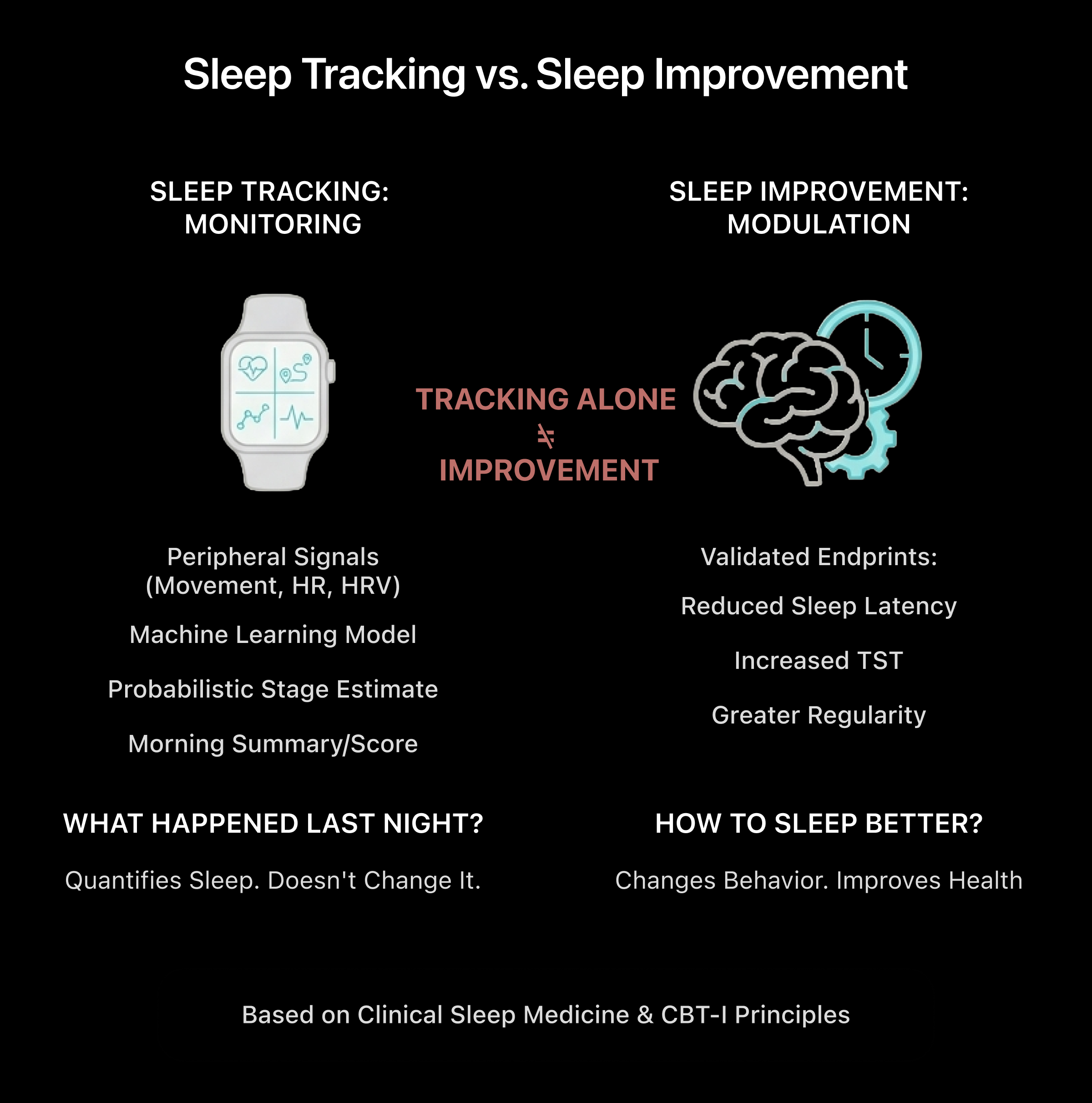
This is what we call an adaptive sleep system: technology that responds to your body in real time, rather than passively recording what happened after the fact. AVI should be considered complementary to behavioral sleep strategies and clinical evaluation where appropriate. It's not a replacement for foundational sleep hygiene or professional care. It's an additional layer of support, working at the physiological level, during the night itself.
7. The bigger picture
Waking up in the middle of the night is not something you should just push through. It's your body signaling that the sleep maintenance process needs support. Whether that support comes from behavioral changes, environmental adjustments, or emerging technology like Active Vibrational Intervention, the goal is the same: helping your body do what it's designed to do.
Sleep deeply. Continuously. And restoratively. You deserve to wake up feeling like it.
Frequently Asked Questions
Waking around 3am happens because two biological systems collide at the wrong moment. Your adenosine (sleep pressure) has dropped significantly during the night's earlier deep sleep, while your cortisol is starting its natural pre-dawn rise. That combination creates a window of vulnerability where even small disruptions, like stress, blood sugar changes, or a noise, are enough to pull you fully awake. It's not random. It's biology.
Brief awakenings between sleep cycles are normal for everyone. Most people don't remember them. The issue arises when awakenings become prolonged or frequent enough to reduce total sleep time and sleep efficiency. Research shows that 18.1% of U.S. adults report difficulty staying asleep, so if you're struggling with it, you're far from alone. But common doesn't mean inevitable.
Yes. About 60% of people with chronic insomnia show an overactive HPA axis, which is the stress response system that controls cortisol release. When this system is dysregulated, even low-level stress can trigger an early cortisol surge in the early morning hours, waking you before you're ready. Managing the stress response through behavioral strategies like CBT-I or relaxation techniques is one of the most effective ways to support more consolidated sleep.
Active Vibrational Intervention (AVI) delivers gentle, precisely timed vibrations that respond to your body's own physiological signals during deep sleep, helping to stabilize the phase of the night when you're most vulnerable to disruption. Rather than sedating or masking the problem, it works alongside your body, not against it. Peer-reviewed research on Closed-Loop Vibrational Stimulation found significant improvements in slow-wave activity and sleep quality in poor sleepers. AVI is designed to complement established behavioral sleep strategies, not replace clinical care when it's needed.
More Articles You Might Like






Have questions, want to join us, or simply want to connect? We'd love to hear from you — feel free to reach out at
[email protected]
Sleep, improved in real time
Get early access to Raizz