Definition: Light sleep is an informal label commonly used for stages N1 and N2 of non-REM sleep. It is not a separate clinical sleep stage.
Introduction
If a tracker labels half your night as light sleep, it can feel like a bad report card. That reaction is understandable. “Light” sounds less useful than “deep,” so it is easy to assume your sleep did not count.
The truth is more reassuring. Light sleep is not failed deep sleep. It is a normal, needed stage that helps you fall asleep, stay asleep, and move through the rest of the night’s rhythm.
In this guide, we will unpack the sleep cycle in plain language, compare lighter stages with deep sleep and REM, use a simple analogy, and look at real-life examples. By the end, you will know what to notice in your own patterns without chasing a perfect score.
Where does light sleep fit in the sleep cycle?
In everyday language, light sleep usually refers to stages N1 and N2 of non-REM sleep. N1 is the transition between wakefulness and sleep. N2 is a more stable stage marked by characteristic patterns of brain activity, while heart rate slows and body temperature drops.
Most adults move through several cycles each night. These include N1, N2, deep sleep, and REM. The National Institute of Neurological Disorders and Stroke explains that sleep stages repeat across the night in cycles, rather than happening as one long block.
These lighter stages often make up the largest share of total sleep. That does not mean your night was poor. They help bridge wakefulness, deeper body recovery, and dream-rich REM periods.
How it works
Sleep is more like a dimmer switch than an on-off button. In its lighter stages, awareness has turned down, but you are easier to stir than during deep sleep.
On an EEG, N2 is identified partly by sleep spindles and K-complexes. Sleep specialists use these characteristic electrical patterns to distinguish N2 from other stages.
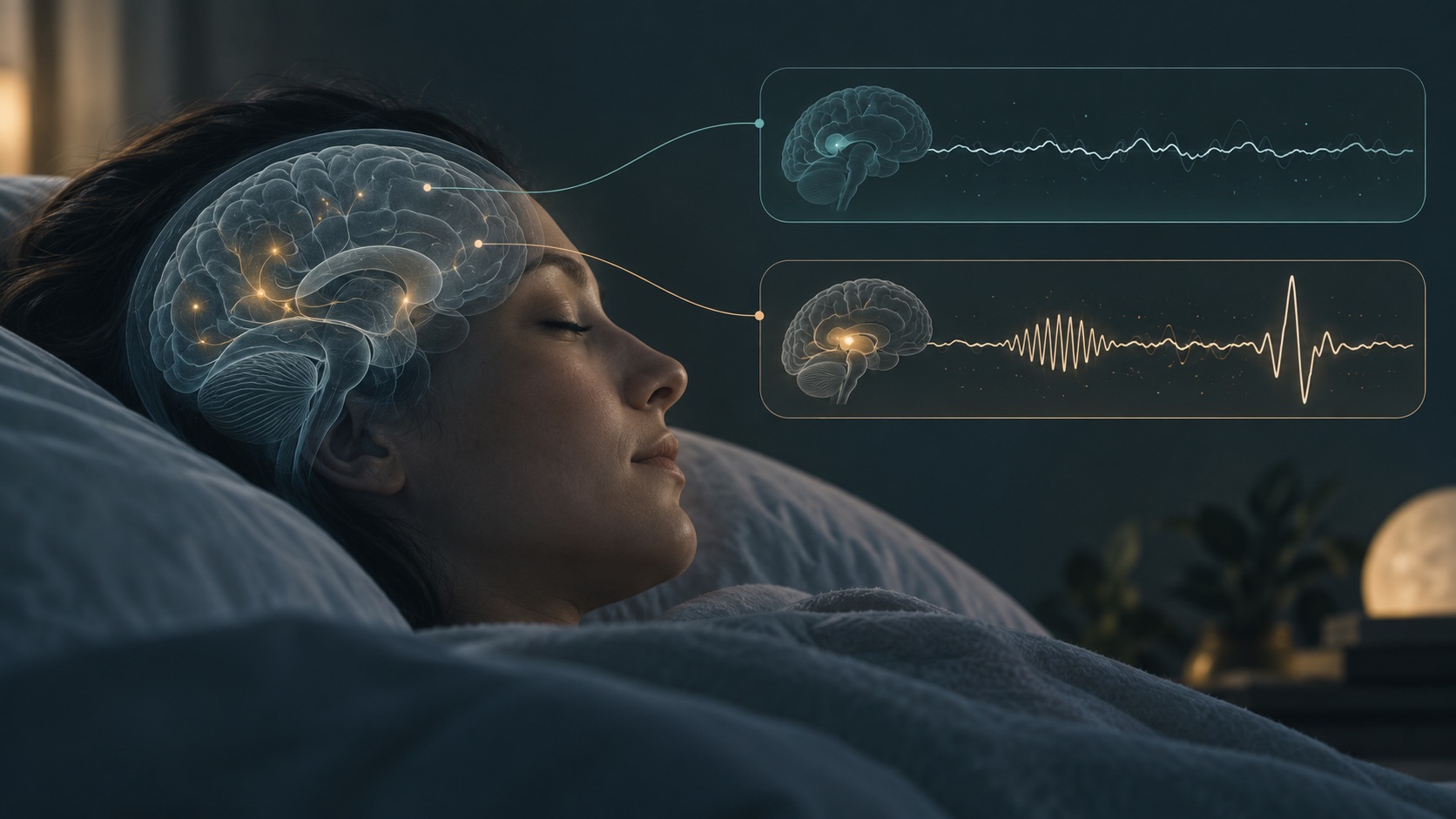
How do the lighter stages support the whole night?
Think of light sleep as the body’s staging area. It helps you enter sleep, change depth, and return after brief arousals. A night without stable transitions would be like a house with rooms but no hallways.
Deep sleep includes prominent slow-wave brain activity, while REM sleep is strongly associated with vivid dreaming and memory processing. N1 and N2 help connect those states into a working sequence.
A common question is how much deep sleep should you get per night. In healthy adults, N3 sleep often accounts for roughly 13 to 23 percent of total sleep, although age and nightly conditions can shift that range. This clinical overview of sleep staging also shows that N2 usually occupies a much larger share of the night. If you ask how much deep sleep should you get, remember that continuity matters as much as minutes.
The analogy: your night is an airport
Imagine your sleep cycle as an airport. The lighter stages are the terminal. Deep sleep is the maintenance hangar, where the aircraft gets serviced. REM is the flight simulator, where the brain runs emotional scenes and memory patterns.
A good airport does not try to keep every plane in the hangar all night. It needs open gates, smooth timing, and few delays. Your night works the same way.
If every transition is interrupted, even a long night can feel tiring. If transitions are smooth, a normal mix of stages can leave you feeling more settled in the morning.

What happens during N1 and N2?
The lighter part of sleep is not one single state. Its layers show how the brain moves from alertness into deeper rest. Understanding them helps you read sleep data with less anxiety.
| Component | Plain-language meaning | Clinical role | Important note |
|---|---|---|---|
| N1 sleep | The first drift from awake to asleep | The first stage of non-REM sleep | People are usually easy to wake during this stage |
| N2 sleep | A more established non-REM stage | Makes up a substantial share of sleep in adults | It is identified by characteristic EEG activity |
| Sleep spindles | Brief bursts of rhythmic brain activity | Help sleep specialists identify N2 on an EEG | Consumer wearables do not measure them directly |
| K-complexes | Large, distinct brain-wave patterns | Also help sleep specialists identify N2 on an EEG | Consumer wearables do not measure them directly |
The goal is not to remove these stages. It is to reduce avoidable interruptions so your body can move through the full cycle more smoothly.
The National Heart, Lung, and Blood Institute notes that sleep supports the brain, heart, metabolism, hormones, and immune function. That broad role is why single-stage scorekeeping can be misleading. Your body benefits from the full architecture of sleep, not just one impressive number.
How lighter stages show up in real life
1. The “I heard everything” night
You went to bed on time, but the room was warm and street noise kept slipping in. You slept, yet you remember cars, footsteps, or your partner moving. Those memories may reflect noticeable awakenings, but they do not tell you which sleep stage you were in.
One night like this is common. A pattern of many nights like this may point to environmental triggers. Temperature, light, sound, and mattress comfort are good places to start.
2. The stress rehearsal night
Your body lies down, but your mind keeps practicing tomorrow. You drift off, rise back toward waking, think again, and repeat. The early stages can feel like a revolving door.
A short wind-down routine can help lower the mental volume. Keep it simple: dim light, a repeated cue, quiet reading, or slow breathing. The routine matters because repetition teaches the brain what comes next.
3. The early-morning waking window
Deep N3 sleep is concentrated earlier in the night, while REM periods generally become longer later. As morning approaches, environmental cues such as light, noise, or temperature changes may wake you more easily.
Blackout curtains, a steady wake time, and a cooler room can help. So can avoiding the habit of checking the time, because clock-checking often turns a brief arousal into full alertness.
How should you read sleep-stage data without chasing scores?
Use tracker data as a clue, not a verdict. Consumer wearables provide probabilistic sleep-stage estimates rather than direct EEG-based staging, and their stage percentages are not validated clinical endpoints. A high N1/N2 estimate can still be normal, especially if you wake refreshed and your schedule is steady. Read it alongside bedtime, caffeine, stress, exercise, alcohol, room conditions, and sleep latency. The American Academy of Sleep Medicine advises that consumer sleep technology should not replace validated diagnostic testing or an appropriate clinical evaluation.
Here is a practical way to interpret common patterns:
| Pattern you notice | Possible meaning | First adjustment to try |
|---|---|---|
| More lighter-stage sleep after late meals | Digestion may be keeping the body active | Finish heavy meals earlier |
| More awakenings after alcohol | Sleep may be more fragmented | Reduce or move alcohol earlier |
| Lighter stages plus racing thoughts | Stress arousal may be high | Add a predictable wind-down routine |
| Early waking with light exposure | Morning cues may be arriving too soon | Reduce dawn light and room noise |
| One odd night | Normal variation | Watch the weekly trend |
Research suggests that gentle vibration matched to body rhythms may support sleep continuity, although the evidence is still limited. A 2024 study of 27 adults with poor sleep quality compared one stimulation night with one sham night. The stimulation condition was associated with less wake after sleep onset and changes in parasympathetic and slow-wave activity. The study used a smart mattress rather than a wrist-worn device, so its findings should not be treated as direct proof of outcomes from any specific consumer wearable.
raizz is an AI sleep wearable brand designed to go beyond passive tracking. The raizz Band provides adaptive, closed-loop sleep support that responds with vibration to signs of restlessness inferred from peripheral signals such as movement and heart-rate patterns. It aims to support sleep continuity and more consolidated sleep periods rather than diagnose sleep stages or cortical arousals. Its app helps users review estimated patterns across awake time, REM, lighter and deeper sleep, settled moments, and restless moments. Adaptive sleep support should be considered complementary to behavioral sleep strategies and clinical evaluation where appropriate.
Expert takeaway
Light sleep is not the weak link in your night. It is part of normal sleep architecture and helps the brain move between wakefulness, deeper non-REM sleep, and REM.
The practical lesson is simple: do not fear lighter stages. Focus on continuity. A smooth night with normal transitions may be more valuable than an impressive stage score paired with frequent interruptions.
Instead of only asking, “What was my score?” ask, “What patterns shaped my night, and what can I adjust tomorrow?” That question is more useful and easier to act on.
raizz
Your Tomorrow Starts Tonight.
raizz turns nightly patterns into clearer sleep decisions.
You do not need to optimize every minute. Give your sleep system consistent cues such as darkness, steadiness, comfort, and time, then judge the pattern across several nights.
Light sleep FAQ
What does light sleep mean?
It means the lighter part of non-REM sleep, mainly N1 and N2. These stages help you drift off, filter the outside world, and move through the full sleep cycle.
Is light sleep bad?
No. It is normal and necessary. It becomes more relevant when paired with frequent waking, restless nights, or poor daytime energy.
Why do I get so much light sleep?
Common reasons include stress, late caffeine, alcohol, noise, heat, irregular timing, and normal aging. One night is not enough to judge. Look for repeated patterns.
Should I try to increase deep sleep only?
No. Deep sleep matters, but good rest depends on all sleep stages working together. Focus on regular timing, fewer disruptions, and how you feel during the day.
When should I talk to a professional?
Consider getting professional guidance if poor sleep quality, heavy daytime sleepiness, loud snoring, breathing pauses, or ongoing fatigue affect daily life. Sleep data can be useful, but your lived experience matters too.


